Narissa
Kentfield
Narissa
Kentfield
Supporting Neurodiversity at SGN
Award-winning neurodiversity learning that influenced cultural change.
About the project
The neurodiversity project closed a clear gap in workplace support for neurodivergent colleagues. I ran focus groups to understand real experiences and created a set of learning resources that built awareness, reduced stigma and made simple adjustments easier to access. The content improved confidence, encouraged people to speak up and influenced how SGN approaches inclusion across the business.
Tools used
ARTICULATE RISE
ARTICULATE STORYLINE
CANVA
ADOBE PHOTOSHOP
VYOND
Purrkins Café
Supporting Neurodiversity at SGN
Supporting Neurodiversity at SGN
Interactive barista training featuring realistic scenarios, performance feedback, and a questionable amount of cat puns.
Award-winning neurodiversity learning that influenced cultural change.
Award-winning neurodiversity learning that influenced cultural change.
About the project
About the project
About the project
Purrkins Café gives new café staff a place to learn the basics before their first real shift.
It teaches key skills in a playful setting, helps build confidence, and shows that you can create simulation style learning in Rise with careful design and a bit of experimentation.
I created the entire experience in Rise, adding my own interactions, visuals, and custom code to make it more engaging and realistic than the standard Rise experience.
The neurodiversity project closed a gap in workplace support for neurodivergent colleagues. I ran focus groups to understand real experiences and created a set of learning resources that built awareness, reduced stigma and made simple adjustments easier to access. The content improved confidence, encouraged people to speak up and influenced how SGN approaches inclusion across the business.
The neurodiversity project closed a gap in workplace support for neurodivergent colleagues. I ran focus groups to understand real experiences and created a set of learning resources that built awareness, reduced stigma and made simple adjustments easier to access. The content improved confidence, encouraged people to speak up and influenced how SGN approaches inclusion across the business.
Tools used
ARTICULATE RISE
ARTICULATE STORYLINE
CANVA
ADOBE PHOTOSHOP
VYOND
ARTICULATE RISE
ARTICULATE STORYLINE
CANVA
ADOBE PHOTOSHOP
VYOND
Case study
Problem and needs analysis
During my time at SGN, I discovered that candidates were being supported during recruitment by sharing interview questions in advance. It was a great step, but once they started working, there was no visible support available.
Around 1 in 7 people are neurodivergent. With over 4,000 employees, that meant hundreds of colleagues were facing daily barriers. I pitched the idea to Ability@SGN to develop bespoke e-learning that addressed this gap.
I ran focus groups with colleagues across the business. Nearly half hadn't disclosed their neurodivergence to managers due to stigma and fear of being treated differently. They were masking their challenges, burning out and worried about career progression. The adjustments they needed were small—flexible time, multiple formats, space for different ways of working—but without empathy and understanding, nothing would change.
The research revealed two types of barriers: those that learning could address (awareness, understanding, stigma) and those requiring organisational change (management practices, workplace culture). I flagged the organisational issues to leadership and focussed my project on building foundational understanding and reducing stigma across the business.
Solution
To address the stigma and lack of awareness identified in the research, I created learning resources and focussed on wider organisational influence with three clear goals:
Provide accessible central support - Build SharePoint hubs where colleagues, managers and neurodivergent individuals could easily find resources specific to their needs, ensuring everyone knows support is available.
Build empathy and reduce barriers to speaking up- Build content within the hubs that helps managers and colleagues understand neurodiversity through educational videos and guides, alongside self-help resources and a self-advocacy template to empower neurodivergent colleagues to request adjustments.
Influence wider organisational change - Share findings with other teams to help them evaluate accessibility in their own practices, from recruitment to communications, and promote the hubs through marketing campaigns.
I created dedicated hubs for ADHD and dyslexia. I originally planned a full suite covering additional conditions, but other projects took priority. Focusing on these two first meant I could launch something that addressed the most common needs identified in the focus groups.
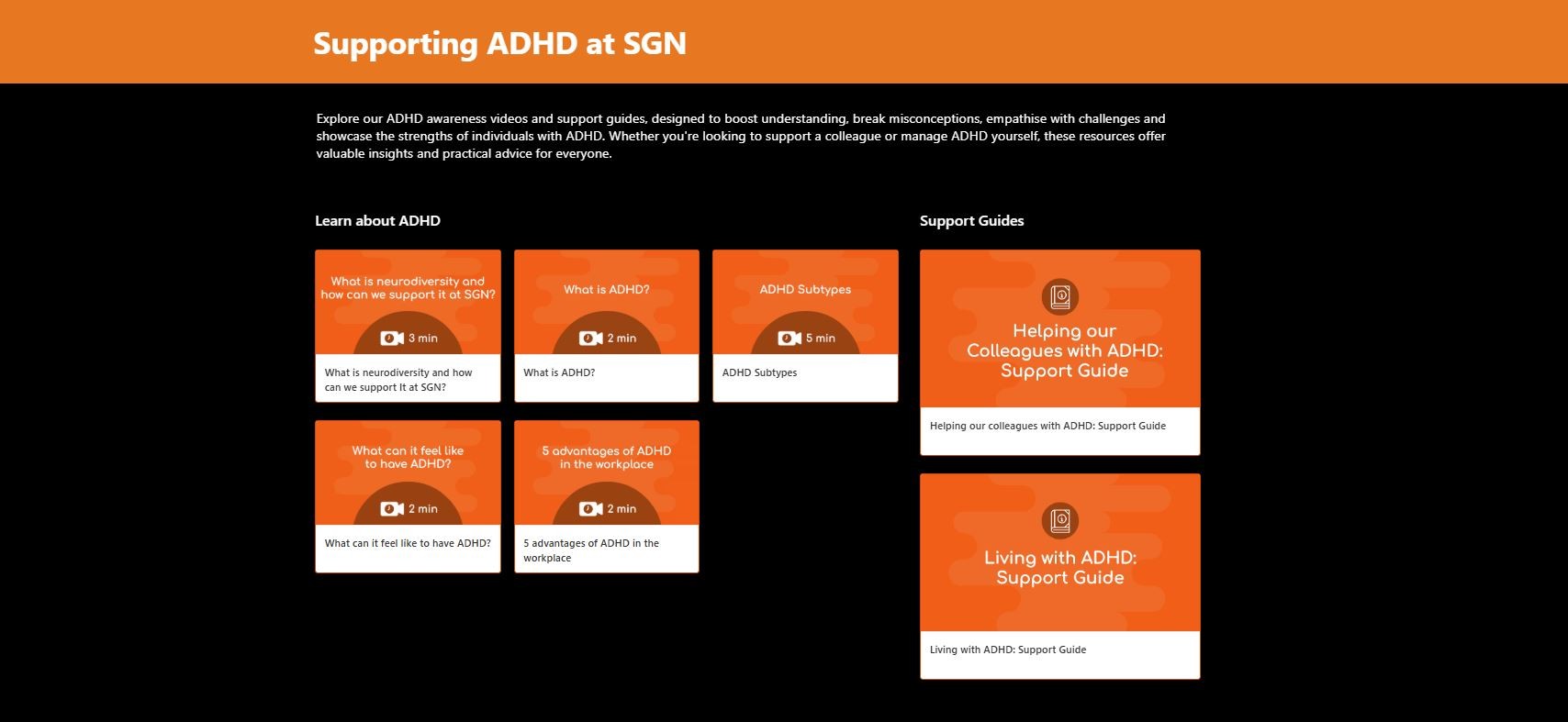
Support hub
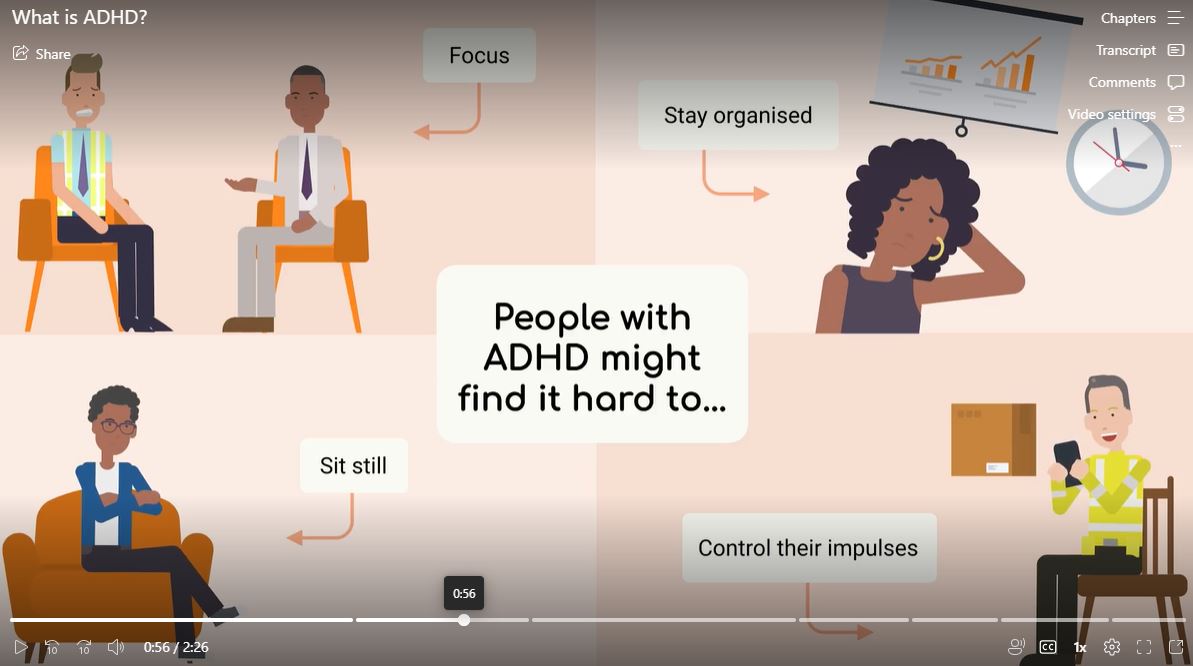
Educational videos
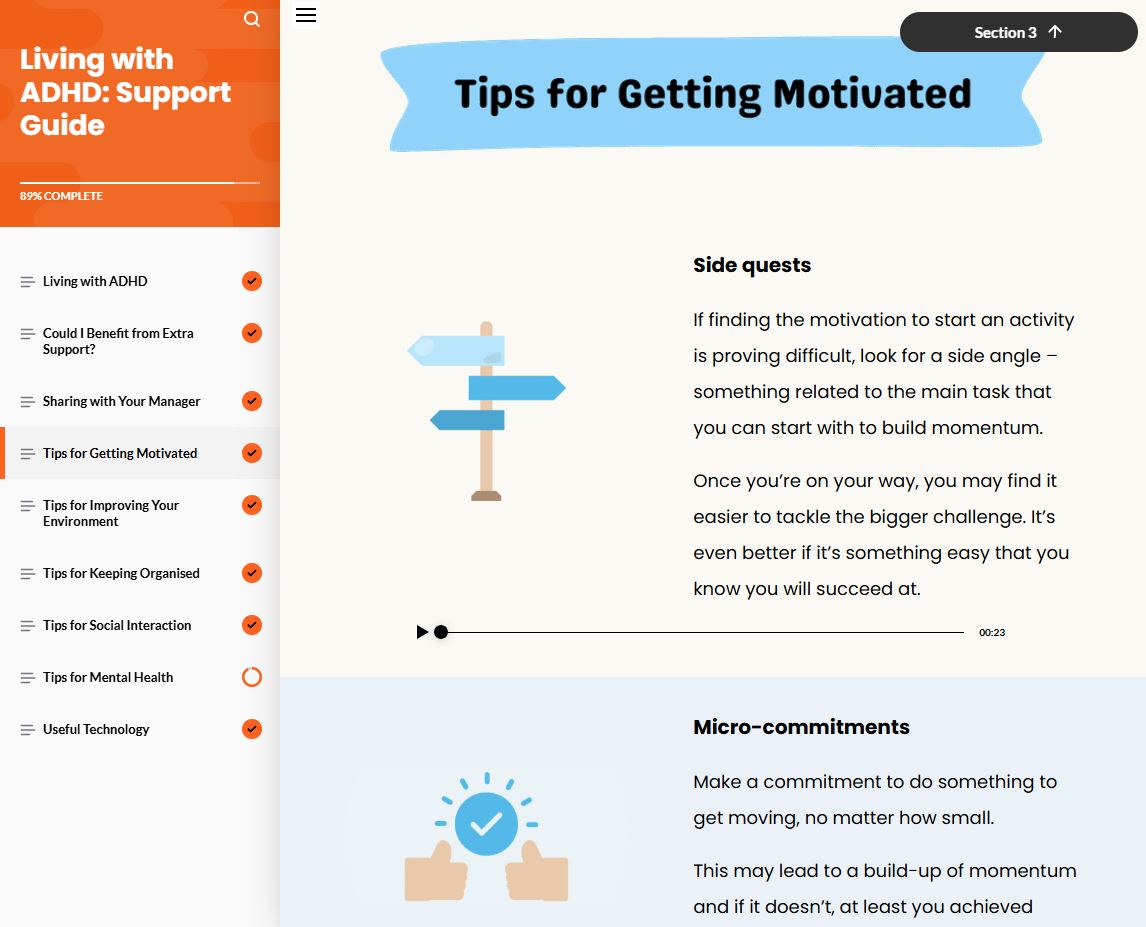
Support guides
Design approach
A key consideration for this project was ensuring maximum accessibility. I researched what works for neurodivergent people across different conditions, drawing on guidance from organisations like the British Dyslexia Association as well as research on ADHD and cognitive load.
This informed specific design choices: optional audio on every page, colour-coded sections, short text chunks with clear line spacing, careful pacing and a conversational tone. I designed everything in short bursts—no longer than 5 minutes—making content easier to absorb for neurodivergent learners and reducing the barrier to engagement as the learning wasn't mandatory. I also created a version of the dyslexia support guide using OpenDyslexic font.
Throughout development, I consulted the focus group participants and Ability@SGN network, showing prototypes to strengthen the content.
I built the resources in Articulate Rise for its accessibility features and mobile responsiveness, using Storyline for interactive elements and Vyond for character-driven animations.
Impact
Colleagues began speaking up and requesting adjustments, and Occupational Health started actively directing people to the resources. Although measurable outcomes weren’t possible due to the sensitivity of the subject and data protection constraints, the impact was visible. HR, Occupational Health, managers and wellbeing champions fed back that the guides and videos were being used in real conversations, helping colleagues request support earlier.
I promoted the hubs through the intranet, SGN app, monthly team talks and wellbeing champions. Comms used it in team talks, and Occupational Health incorporated it into their wellbeing resources. It was added to new-hire inductions, increasing awareness from day one.
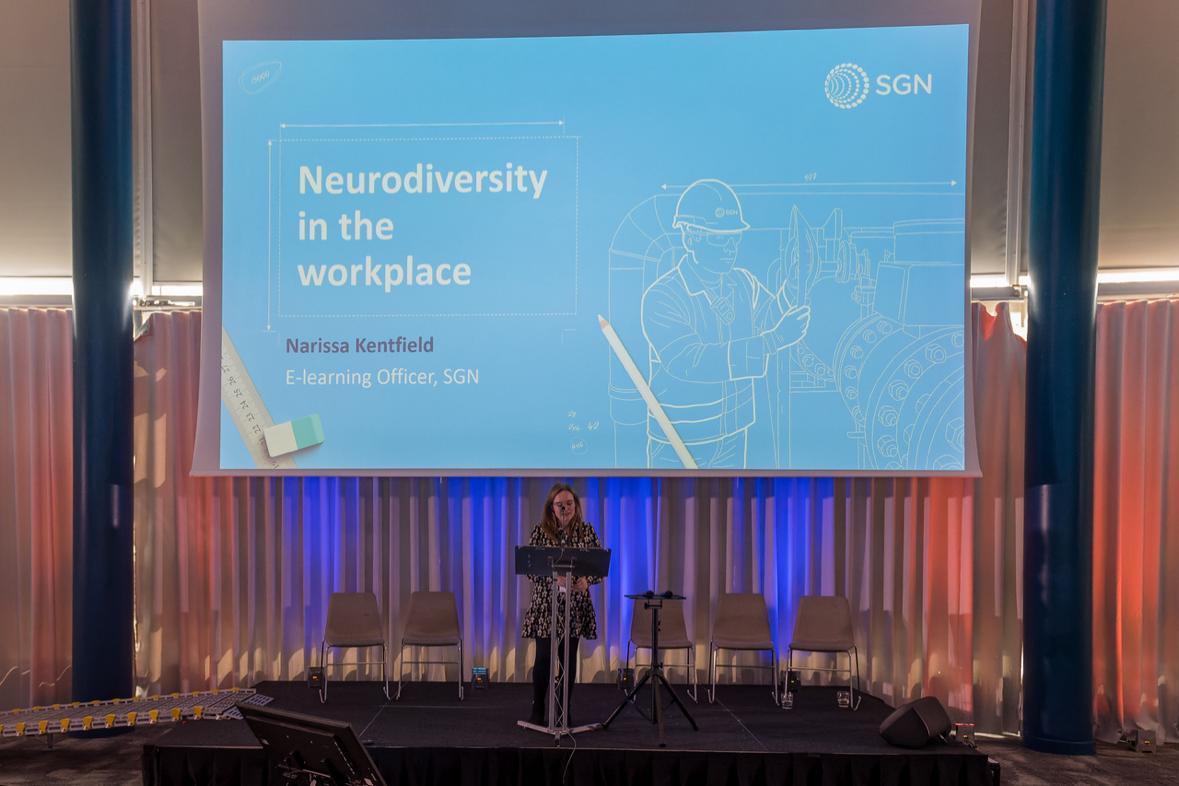
After presenting the project at National Inclusion Week, three other UK gas networks reached out asking for guidance to create their own resources. The project received the SGN Star Award for Inclusion and influenced later initiatives, ensuring safety-critical training for frontline responders was designed with inclusivity in mind.
What this taught me
This project changed how I approach design. I realised accessibility isn’t just about making content WCAG-compliant; it’s about understanding the human barriers that prevent people from asking for help.
I now start every project by asking what might stop someone from engaging, not just what they need to learn. I build in user consultation throughout development, not just at the start. And I've stopped assuming I know what "accessible" means, I ask the people who'll actually use it.
This project taught me that sometimes the learning intervention isn’t the solution. It’s the cultural conditions around it that make real change possible.
Case study
Problem and needs analysis
During my time at SGN, I discovered that candidates were being supported during recruitment by sharing interview questions in advance. It was a great step, but once they started working, there was no visible support available.
Around 1 in 7 people are neurodivergent. With over 4,000 employees, that meant hundreds of colleagues were facing daily barriers. I pitched the idea to Ability@SGN to develop bespoke e-learning that addressed this gap.
I ran focus groups with colleagues across the business. Nearly half hadn't disclosed their neurodivergence to managers due to stigma and fear of being treated differently. They were masking their challenges, burning out and worried about career progression. The adjustments they needed were small—flexible time, multiple formats, space for different ways of working—but without empathy and understanding, nothing would change.
The research revealed two types of barriers: those that learning could address (awareness, understanding, stigma) and those requiring organisational change (management practices, workplace culture). I flagged the organisational issues to leadership and focussed my project on building foundational understanding and reducing stigma across the business.
Solution
To address the stigma and lack of awareness identified in the research, I created learning resources and focussed on wider organisational influence with three clear goals:
Provide accessible central support - Build SharePoint hubs where colleagues, managers and neurodivergent individuals could easily find resources specific to their needs, ensuring everyone knows support is available.
Build empathy and reduce barriers to speaking up- Build content within the hubs that helps managers and colleagues understand neurodiversity through educational videos and guides, alongside self-help resources and a self-advocacy template to empower neurodivergent colleagues to request adjustments.
Influence wider organisational change - Share findings with other teams to help them evaluate accessibility in their own practices, from recruitment to communications, and promote the hubs through marketing campaigns.
I created dedicated hubs for ADHD and dyslexia. I originally planned a full suite covering additional conditions, but other projects took priority. Focusing on these two first meant I could launch something that addressed the most common needs identified in the focus groups.
Support hub
Educational videos
Support guides
Design approach
A key consideration for this project was ensuring maximum accessibility. I researched what works for neurodivergent people across different conditions, drawing on guidance from organisations like the British Dyslexia Association as well as research on ADHD and cognitive load.
This informed specific design choices: optional audio on every page, colour-coded sections, short text chunks with clear line spacing, careful pacing and a conversational tone. I designed everything in short bursts—no longer than 5 minutes—making content easier to absorb for neurodivergent learners and reducing the barrier to engagement as the learning wasn't mandatory. I also created a version of the dyslexia support guide using OpenDyslexic font.
Throughout development, I consulted the focus group participants and Ability@SGN network, showing prototypes to strengthen the content.
I built the resources in Articulate Rise for its accessibility features and mobile responsiveness, using Storyline for interactive elements and Vyond for character-driven animations.
Impact
Colleagues began speaking up and requesting adjustments, and Occupational Health started actively directing people to the resources. Although measurable outcomes weren’t possible due to the sensitivity of the subject and data protection constraints, the impact was visible. HR, Occupational Health, managers and wellbeing champions fed back that the guides and videos were being used in real conversations, helping colleagues request support earlier.
I promoted the hubs through the intranet, SGN app, monthly team talks and wellbeing champions. Comms used it in team talks, and Occupational Health incorporated it into their wellbeing resources. It was added to new-hire inductions, increasing awareness from day one.
After presenting the project at National Inclusion Week, three other UK gas networks reached out asking for guidance to create their own resources. The project received the SGN Star Award for Inclusion and influenced later initiatives, ensuring safety-critical training for frontline responders was designed with inclusivity in mind.
What this taught me
This project changed how I approach design. I realised accessibility isn’t just about making content WCAG-compliant; it’s about understanding the human barriers that prevent people from asking for help.
I now start every project by asking what might stop someone from engaging, not just what they need to learn. I build in user consultation throughout development, not just at the start. And I've stopped assuming I know what "accessible" means, I ask the people who'll actually use it.
This project taught me that sometimes the learning intervention isn’t the solution. It’s the cultural conditions around it that make real change possible.
Case study
Problem and needs analysis
During my time at SGN, I discovered that candidates were being supported during recruitment by sharing interview questions in advance. It was a great step, but once they started working, there was no visible support available.
Around 1 in 7 people are neurodivergent. With over 4,000 employees, that meant hundreds of colleagues were facing daily barriers. I pitched the idea to Ability@SGN to develop bespoke e-learning that addressed this gap.
I ran focus groups with colleagues across the business. Nearly half hadn't disclosed their neurodivergence to managers due to stigma and fear of being treated differently. They were masking their challenges, burning out and worried about career progression. The adjustments they needed were small—flexible time, multiple formats, space for different ways of working—but without empathy and understanding, nothing would change.
The research revealed two types of barriers: those that learning could address (awareness, understanding, stigma) and those requiring organisational change (management practices, workplace culture). I flagged the organisational issues to leadership and focussed my project on building foundational understanding and reducing stigma across the business.
Solution
To address the stigma and lack of awareness identified in the research, I created learning resources and focussed on wider organisational influence with three clear goals:
Provide accessible central support - Build SharePoint hubs where colleagues, managers and neurodivergent individuals could easily find resources specific to their needs, ensuring everyone knows support is available.
Build empathy and reduce barriers to speaking up- Build content within the hubs that helps managers and colleagues understand neurodiversity through educational videos and guides, alongside self-help resources and a self-advocacy template to empower neurodivergent colleagues to request adjustments.
Influence wider organisational change - Share findings with other teams to help them evaluate accessibility in their own practices, from recruitment to communications, and promote the hubs through marketing campaigns.
I created dedicated hubs for ADHD and dyslexia. I originally planned a full suite covering additional conditions, but other projects took priority. Focusing on these two first meant I could launch something that addressed the most common needs identified in the focus groups.
Support hub
Educational videos
Support guides
Design approach
A key consideration for this project was ensuring maximum accessibility. I researched what works for neurodivergent people across different conditions, drawing on guidance from organisations like the British Dyslexia Association as well as research on ADHD and cognitive load.
This informed specific design choices: optional audio on every page, colour-coded sections, short text chunks with clear line spacing, careful pacing and a conversational tone. I designed everything in short bursts—no longer than 5 minutes—making content easier to absorb for neurodivergent learners and reducing the barrier to engagement as the learning wasn't mandatory. I also created a version of the dyslexia support guide using OpenDyslexic font.
Throughout development, I consulted the focus group participants and Ability@SGN network, showing prototypes to strengthen the content.
I built the resources in Articulate Rise for its accessibility features and mobile responsiveness, using Storyline for interactive elements and Vyond for character-driven animations.
Impact
Colleagues began speaking up and requesting adjustments, and Occupational Health started actively directing people to the resources. Although measurable outcomes weren’t possible due to the sensitivity of the subject and data protection constraints, the impact was visible. HR, Occupational Health, managers and wellbeing champions fed back that the guides and videos were being used in real conversations, helping colleagues request support earlier.
I promoted the hubs through the intranet, SGN app, monthly team talks and wellbeing champions. Comms used it in team talks, and Occupational Health incorporated it into their wellbeing resources. It was added to new-hire inductions, increasing awareness from day one.
After presenting the project at National Inclusion Week, three other UK gas networks reached out asking for guidance to create their own resources. The project received the SGN Star Award for Inclusion and influenced later initiatives, ensuring safety-critical training for frontline responders was designed with inclusivity in mind.